
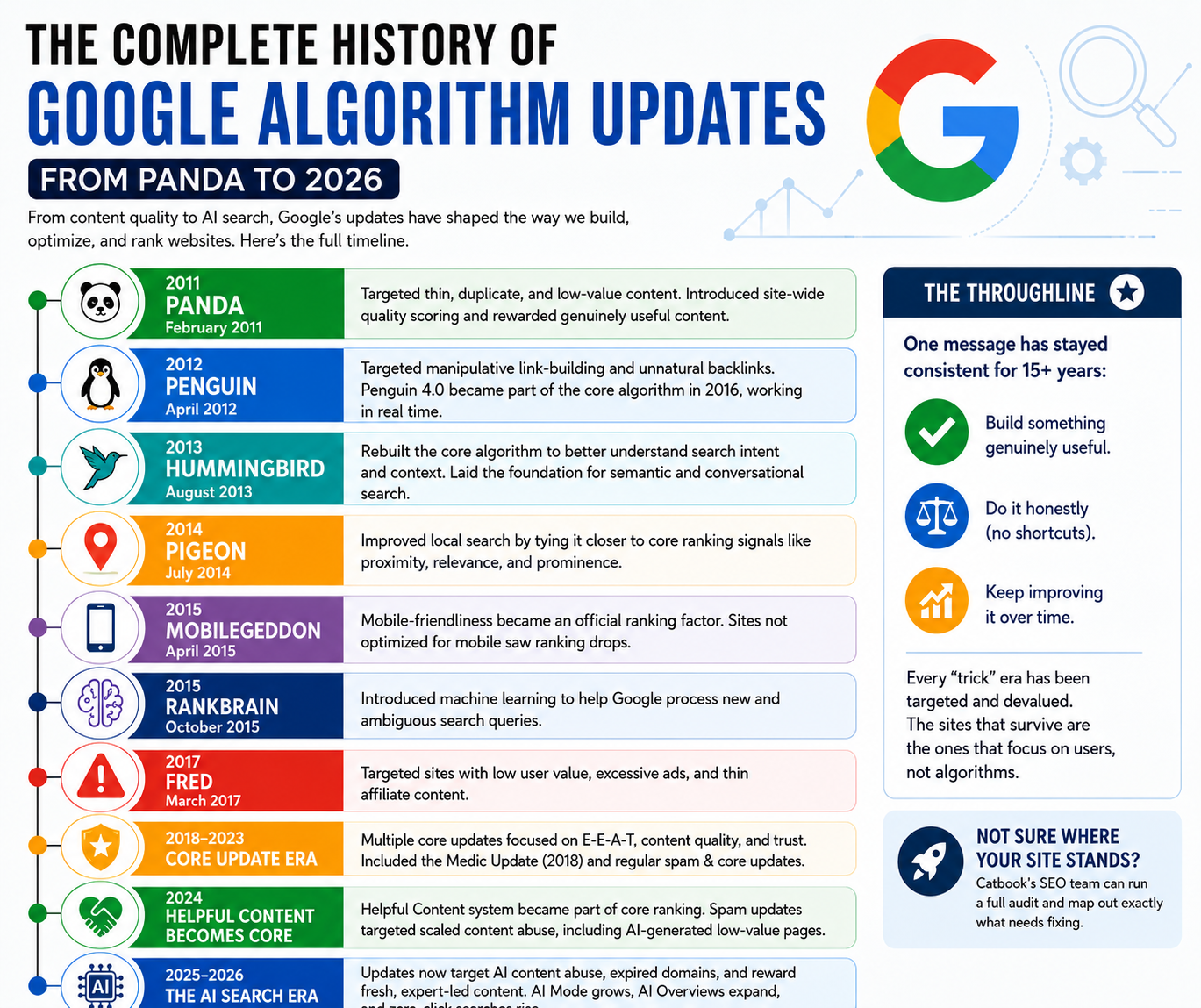
Every business owner who’s ever watched their website traffic suddenly rise or fall for no obvious reason has felt the effects of a Google algorithm update. Since Google’s earliest days, it has quietly rewritten the rules of search hundreds, if not thousands, of times. But a handful of these updates were big enough, and disruptive enough, to earn their own names and reshape SEO permanently.
At Catbook Advertising & Designing, understanding this history isn’t just trivia — it’s the foundation of how we approach SEO for every client. Here’s the full timeline, from the update that started it all to what’s rolling out right now in 2026.
Panda (February 2011)
Panda was the update that changed everything. Before Panda, thin, duplicated, and low-value content could still rank well simply by targeting the right keywords. Panda introduced site-wide quality scoring, meaning Google started judging a website’s overall usefulness rather than evaluating pages in isolation. Content farms — sites built purely to churn out low-effort articles for ad revenue — were hit hardest. Named after a Google engineer, Panda impacted roughly 12% of search queries when it launched, and its core principle, reward genuinely useful content, still underpins every update that’s followed.
Penguin (April 2012)
If Panda was about content quality, Penguin was about link quality. It targeted manipulative link-building: keyword-stuffed anchor text, link schemes, and unnatural backlink profiles built purely to game rankings. Sites that had built their entire SEO strategy on buying or trading links saw dramatic ranking drops almost overnight. Penguin went through several versions before becoming part of Google’s core algorithm in 2016 (Penguin 4.0), at which point it started working in real time — meaning a site could recover as soon as it cleaned up its backlink profile, instead of waiting months for the next refresh.
Hummingbird (August 2013)
Hummingbird wasn’t a penalty update — it was a rebuild. Google rewrote its core algorithm to understand the meaning behind a search query, not just the individual keywords in it. This was the beginning of semantic search: Google started interpreting intent and context, which meant pages that clearly and naturally answered a question could rank well even without exact keyword matches. Hummingbird effectively laid the groundwork for everything that would later become conversational search and, eventually, today’s AI-driven search systems.
Pigeon (July 2014)
Pigeon brought this same philosophy to local search. Before Pigeon, local results ran on a somewhat separate set of ranking rules. This update tied local search much more closely to Google’s core web ranking signals, meaning proximity, relevance, and prominence all started working together. For local businesses, this is the update that made accurate listings, consistent business information, and genuine local authority far more important than keyword tricks. If you’ve ever wondered why NAP (name, address, phone number) consistency matters so much for local SEO, Pigeon is the reason.
Mobilegeddon (April 2015)
As mobile search overtook desktop, Google made mobile-friendliness an official ranking factor. Sites that weren’t responsive or mobile-optimized saw real drops in mobile search rankings. This update pushed responsive design from a “nice to have” to an absolute requirement for any serious website.
RankBrain (October 2015)
RankBrain introduced machine learning directly into Google’s ranking system, helping it interpret ambiguous or entirely new search queries it had never seen before. It marked Google’s shift from rule-based ranking toward AI-assisted ranking — a trajectory that’s only accelerated since.
Fred (March 2017)
An unconfirmed but widely recognized update, Fred targeted sites that prioritized ad revenue over user experience — think aggressive ad placements, thin affiliate content, and sites clearly built to extract clicks rather than help visitors.
The Core Update Era (2018–2023)
From 2018 onward, Google shifted toward regular, broad “core updates” released several times a year rather than single named algorithms. These became less about one specific tactic and more about holistically reassessing content quality, expertise, and trustworthiness across the entire index. This era introduced the concept of E-E-A-T (Experience, Expertise, Authoritativeness, Trustworthiness), which remains central to how Google evaluates content today. Notable moments included the Medic Update (2018), which hit health and finance sites hard, and a steady cadence of core and spam updates through 2023.
2024: Helpful Content Becomes Core
In 2024, Google folded its Helpful Content system directly into its core ranking algorithm, cementing “people-first content” as a permanent ranking factor rather than a separate filter. Multiple core and spam updates rolled out through the year, alongside the March 2024 Spam Update, which specifically targeted scaled content abuse — sites using AI to mass-produce low-value pages.
2025–2026: The AI Search Era
Recent core updates have continued to reinforce the same values Google has pushed since Panda: originality, usefulness, and credibility over content built purely to rank. But 2026 has added a new layer entirely. Google’s spam policies now explicitly extend to AI-generated content, and updates like the March 2026 Spam Update specifically target scaled AI content abuse and expired domain manipulation. The March 2026 Core Update also introduced holistic Core Web Vitals scoring, combining loading speed, interactivity, and visual stability into a single composite performance score. The May 2026 Core Update pushed E-E-A-T and content freshness even further, rewarding sites with regularly updated, expert-led content.
Beyond ranking updates, the search landscape itself is shifting. AI Mode in Google Search has passed a billion monthly users, AI Overviews now appear on a significant share of searches, and a growing number of searches end without a click at all. The updates still matter for diagnosing ranking changes, but increasingly, the bigger opportunity is becoming a source that Google’s AI systems actually cite.
The Throughline
Look across fifteen years of updates, and one message repeats every single time: build something genuinely useful, do it honestly, and keep improving it. Every “trick” era — thin content, spammy links, keyword stuffing, mass-produced AI pages — has eventually been targeted and devalued. The sites that have survived every single one of these updates are the ones that were never trying to outsmart Google in the first place.
If you’re not sure where your website stands against this history, or which past update might still be quietly holding your rankings back, Catbook’s SEO team can run a full audit and map out exactly what needs fixing.